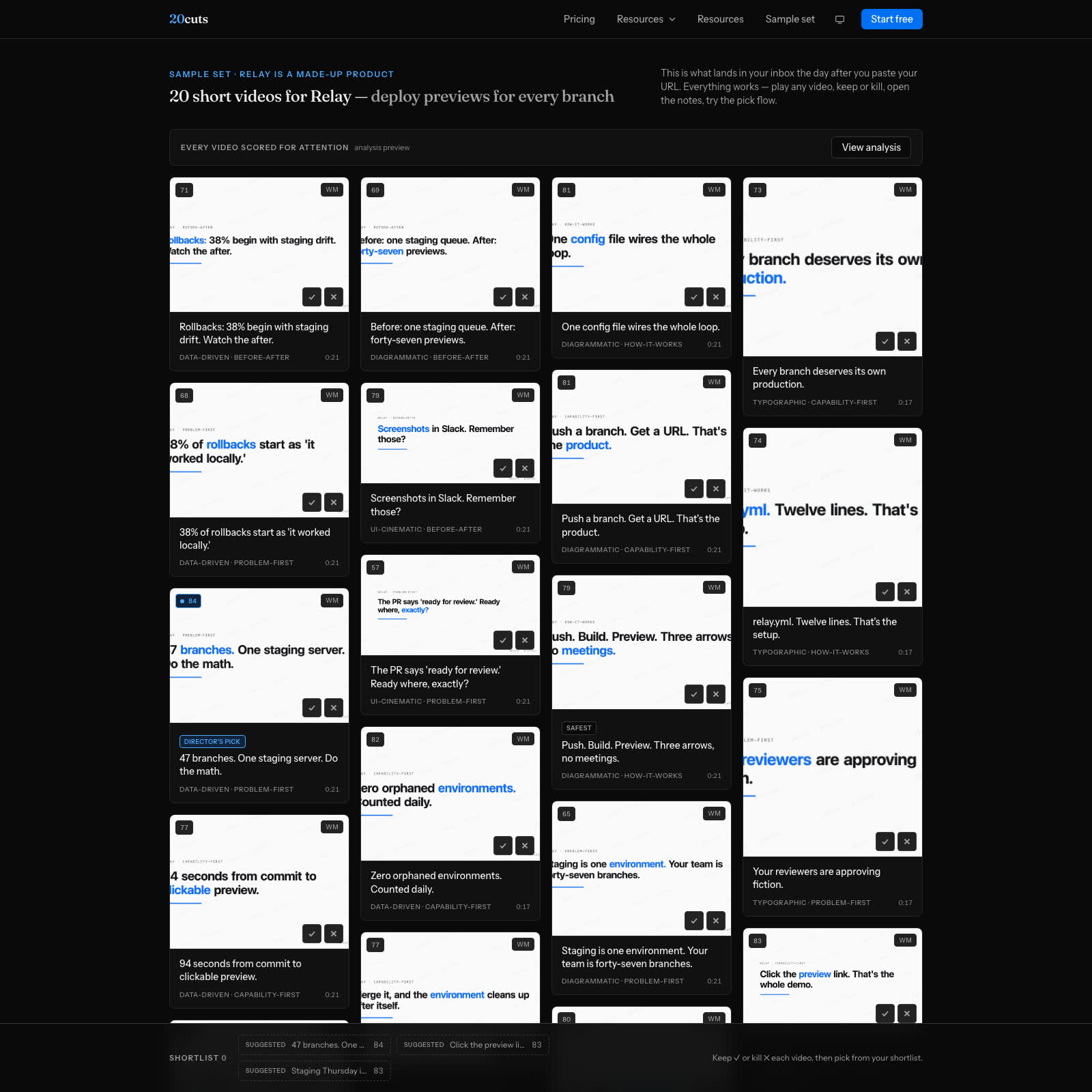
You paste your product's URL, and within 24 hours you get twenty short watermarked videos of your actual product, each with a different hook, style, or angle, free, with no card and no call. You pick the one that is right, and we produce the finished version of exactly that direction.
Why choosing beats describing
Nobody can describe a video they haven't seen. A founder who would struggle for an hour to write "what our video should feel like" can watch twenty real candidates and know the right one in about ninety seconds, because recognition is fast and accurate while description is slow and lossy. The design world learned this years ago with logo contests: show a client one designer's interpretation of their brief and you get three rounds of "not quite," but show them thirty real options and they point.
The traditional agency process runs on description anyway. A discovery call, a creative brief, a script, and a storyboard are four written guesses at what you meant, and each guess needs a meeting to correct it. The most expensive failure in video production is discovering at the end that the direction was wrong, and a brief-driven process cannot surface that until most of the money is spent.
So we moved the direction decision to the front, where it is cheap. A 15–30 second cut is enough to judge a direction completely: the hook, the style, the angle, and whether it feels like your product. Judging twenty of them costs you minutes and costs us a watermark. We apply the same principle inside production: every decision moves to the cheapest artifact that exposes it.
The six stages
1. Send us anything
Intake is four fields: your product's URL, what the video is for, who it is for, and your email. You can add a repo, brand files, or screenshots. We do not ask how long the video should be, because the purpose decides that, and we do not ask your budget, because prices are public.
2. We match your look
We pull your design language from what you sent: colors, type, spacing, and your real screens. Every candidate is built from that, which is why the board does not look like a template with your logo on it. This is the hardest rule we carry over from our sixty-odd produced videos: every frame shows the real product, because invented UI is the fastest way to lose a viewer's trust.
3. We start from what you want a viewer to do
Each video is planned backwards from its goal — a signup, a booking, a purchase. The goal sits at the end, and the scenes are derived by asking what the viewer needs to see, in what order, for that action to make sense. Scenes that do not move the viewer toward the goal get replaced. Planned forward from "what should we show," the same video turns into a feature tour.
4. Every video has to earn its spot
Most viewers decide in the first five seconds whether to keep watching, so that is the bar every candidate is held to. Hooks and styles are paired and scored for attention, and pairings that do not grab in five seconds do not make your twenty.
5. We loop until it clears the bar
Candidates get made, scored, and pruned, with the bar rising each pass, until exactly twenty survive. Your board is a set of survivors — twenty different directions that each cleared the same bar — never the first twenty things made. It arrives 24 hours after your URL.
6. You pick one, and we refine it until you love it
Your pick is the spec. You can attach one note ("this one, but calmer music"), choose a tier, and pay for that one video. Then the finished version gets produced at full length and quality, and revision rounds land your notes on narration, pacing, and color. The first version arrives in 5 business days, or in 72 hours on Flagship.
What the twenty videos are and aren't
They are real videos, 15–30 seconds each, built from your actual product with your actual design language. Each is a genuinely different direction, because twenty variations of one idea would give you nothing to choose between. They are watermarked, and the board stays live for about three weeks.
They are not finished videos. A cut is a direction you can judge; the finished video is longer, fully produced, revised with you, and delivered clean. The board is a spec sheet you can watch, and treating it that way is what keeps it free.
If you never pick one, nothing happens: no calls, at most a couple of emails, then silence. Watching twenty directions for your own product tends to clarify what you want, even if you make the video somewhere else entirely.
What happens after the pick
- Your pick and note are restated back to you. They appear on the order page, so you can see we heard the actual request.
- The first version arrives on the clock. That means 5 business days, or 72 hours on Flagship.
- You review by pointing at moments, not by writing essays. Click a timestamp and leave the note; "0:23 — hold this frame longer" is a complete, actionable review.
- Revision rounds are counted and visible. You get 1, 2, or 3 depending on tier, and you always know which round you are in. Wording, pacing, color, and asset swaps are included, while new scenes or a new thesis are a change order, quoted before any work happens. The scope is printed on the pricing card, which is the whole contract.
- Delivery includes everything you need to publish. Every tier ships 4K and 1080p, captions, and a thumbnail; Pro adds vertical and square cutdowns; Flagship adds the full editable project. Full prices and tiers are on the cost page.
The guarantees
- Every finished video carries a 100% money-back guarantee, no questions asked. The guarantee works economically because you watched twenty real cuts before paying, which filters out the most common failure in video projects, a direction mismatch discovered late, before any money moves.
- You get full commercial rights on every tier. The finished video is yours to use anywhere, for as long as you like.
- Prices are fixed and public. They are stated on the site, with no quote requests and no calls to book.
- A board that misses gets a free re-roll. If none of the twenty is right, tell us what was missing and we run the loop again at no charge.
Using the method without us
You can reuse the method with any vendor, even if you never send us a URL.
- Spec by selection, whatever you buy. Ask a freelancer for three rough style frames before commissioning the video, or ask an agency to show directions before a full storyboard. Any vendor can move a decision to a cheaper artifact if you ask.
- Plan backwards from the viewer's action. Write the action first, then ask what the viewer must see for it to make sense. It reliably kills the feature-tour instinct, and what makes a good explainer video covers the craft side.
- Judge any draft by its first five seconds. Watch it cold and ask whether the first five seconds earn the next five, because that is the same bar your viewers apply.
FAQ
Is the board really free? Yes. There is no card, no call, and no obligation. The cuts are watermarked and the board expires after about three weeks, and expired boards can be revived on request for 30 days.
Why are the cuts 15–30 seconds instead of full length? Because that is what judging a direction takes. The hook, the style, and the feel are all visible in 15 seconds, and viewers decide whether to keep watching in five, so full-length candidates would add nothing to your decision.
What if none of the twenty is right? Say what was missing and we re-roll free, or walk away, having spent zero dollars and about ninety seconds.
Can the finished video differ from the cut I picked? The pick sets the direction, meaning the hook, style, and angle, and your note plus revision rounds shape the rest. It grows to full length and full production quality, and it does not change into a different video.
The board is easier to judge with your own product on it. Send the URL and pick from twenty short videos of it.